Admission portfolios and hiring portfolios are different documents. One proves potential. The other proves you will not slow the team down.
Most students only ever build the first, then wonder why interviews go quiet.
What a hiring manager is actually checking
Can this person take a brief and return something usable? Do they understand construction, not just silhouette? Will their tech pack be readable by a factory? Can they work in the fabric and the price band we operate in? Everything in your portfolio should answer one of those.
Show the process, not only the poster
Include the research, the rejected directions, the flat sketches, the spec sheet, the fit notes. A finished render impresses a relative. A render next to its pattern, its tech pack and its fit correction impresses an employer.
Three to five projects, not fifteen
Depth beats volume. Pick projects with different muscles: one craft-led, one commercial and costed, one digital or AI-assisted, one self-initiated brand concept. Cut everything else. A weak project drags the whole file down.
Make it real
Brief yourself as a client would. Give each project a customer, a season, a price point and a constraint. "Occasionwear for a 26-year-old Delhi buyer, under a set fabric cost" reads as professional. "Exploration of duality" does not.
Digital presentation matters now
A clean PDF under 20MB, a simple web link, and the same work visible on Instagram or Behance. Name the file properly. Put your phone number on page one. These small things separate the callback from the silence.
The EIF approach
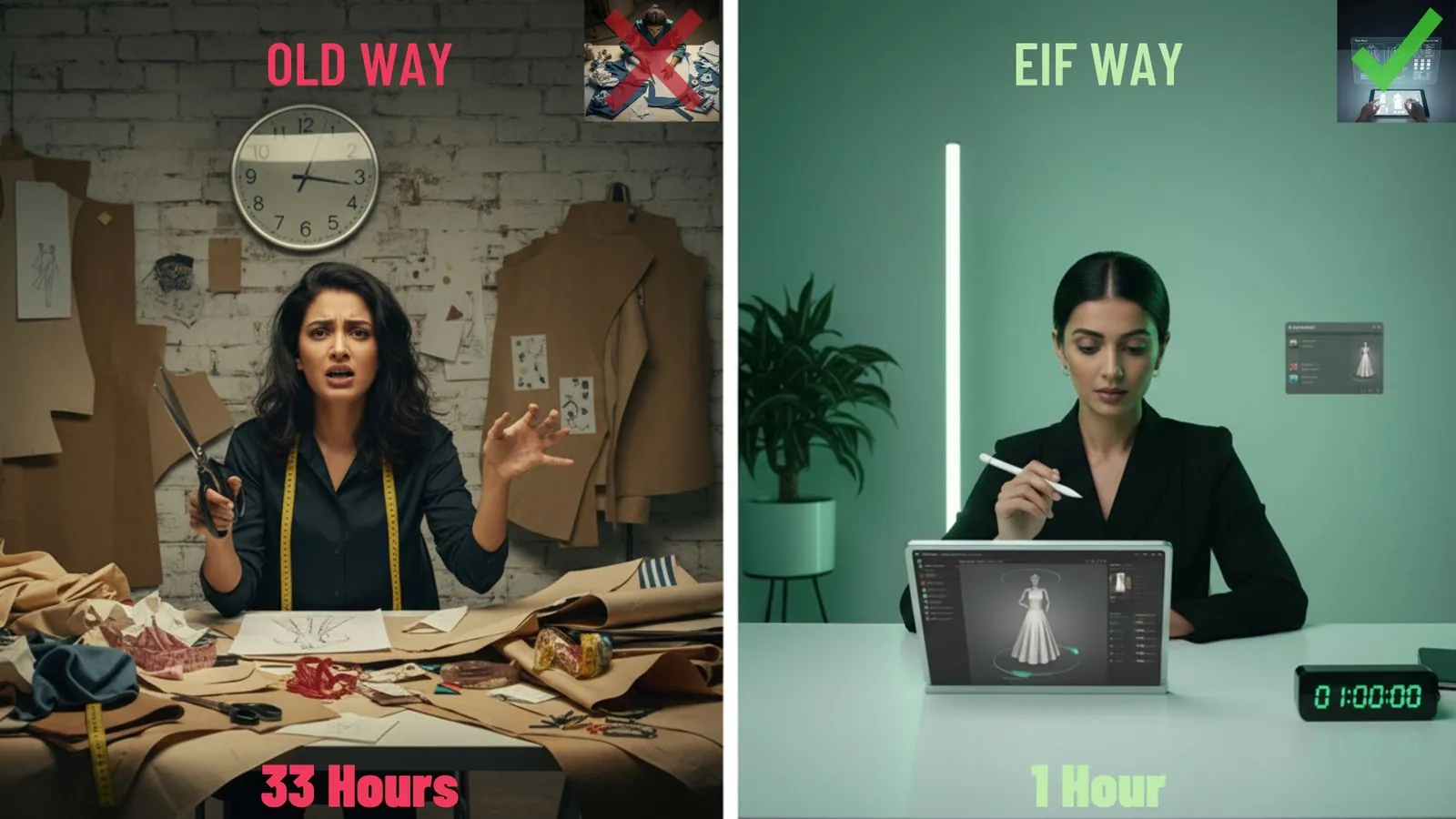
Our students build a portfolio as they train, not in a panic at the end — each module produces a portfolio-grade output, including digital samples produced in the EIF Student Portal.

A portfolio is a promise about what you will be like to work with
Make that promise easy to believe — with process, costing and craft on every page.
Ready to build your future-proof fashion career?
Applications for Batch '26 are open. Seats are limited.
Apply Now